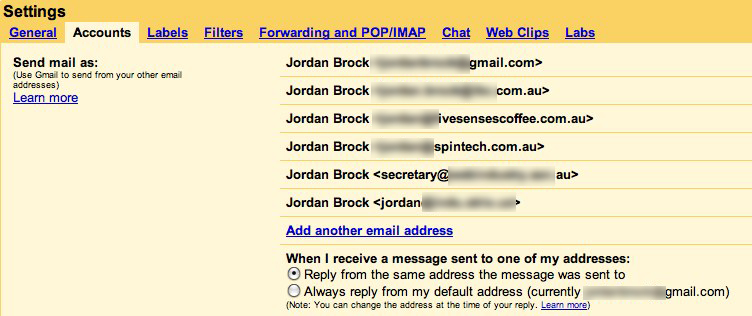
- Free US national calls / Cheap international calls (from 2cents / mins)
- Conference Call in up to 4 parties
- 'Follow-me' calling (great for travelling execs or home workers)
Sunday, March 22, 2009
Google Voice
Tuesday, March 17, 2009
The iPhone Doctor
This will enable the iPhones to pretty much control anything … from your homes central heating, to your hi-fi to your medical diagnostic peripherals.
Johnson & Johnson have already creates a Glucose Monitoring device using it (lifescan), this will no doubt please Diabetics who will now be considering if an iPhone will become a medical expense?
But seriously, what does a diabetic keep with them night and day beside insulin? Their iPhone right? I’m pretty sure this will reduce the overall cost of producing the glucose monitoring device, improve its usability, and potentially grow the total market size for Glucose monitoring industry. I guess the question in the future will be what won’t the iPhone control, Apple intelligent design + monetization of the apps store + potent user interface, will no doubt drive the natural selection of more brilliant apps which will now integrate and embed into our lives even more deeply.
The possibility will really be limitless.
Friday, March 6, 2009
Integrating Life
Would Freud use Skype?
Tuesday, March 3, 2009
254,098 followers can't be wrong ....
Yammer a 'corporate' Twitter, creates closed networks (walled gardens) where only users with the same domain address (e.g .@acmecorp.com) can register (similar to what facebook did when they started, validating affilliation with a US collage). Unlike Twitter which is a true democratised communication channel, Yammers twist (and business model) is based on Corporates wanting to seize control of their networks. For example in the consumer edition of Yammer anyone can say essentially anything (i.e. it's unmoderated). In the paid (Enterprise) edition approved moderators can e.g. remove the offensive / inappropriate comments .
The value of corporate control is clear ... but how realistic is it? - after all employees are already using Twitter, Blogs and other channels outside of corporate control. In a period of history where compliance has never been greater - moderation (read risk mitigation) will be a feature enterprises will want : my conclusion - Yammer will do well.
A wider point perhaps is that Yammer and Twitter do address different social audiences (updating your internal team / business vs. updating the world) - but how sustainable is this division? Are our profressional and personal networks distinct, is there demand for distinction and how will the distinction be managed in the future - through different tools and technologies, or through better channel and message management?
Saturday, February 14, 2009
Mobilizing Sales
Saturday, February 7, 2009
Quick fix through Clicks
Saturday, January 31, 2009
A Newspaper? On a PC? That’s Crazy Talk
Thursday, January 29, 2009
Gmail Speeds Offline
1. Beta Offline acccess i.e. Gmail access without a network connection, early reports are that it actually works better than the online version!! If this claim is true it will be yet another nail in the coffin for client based mail (outlook etc). Why would anyone not want to use web based mail?Saturday, January 24, 2009
New job challenges in the White House
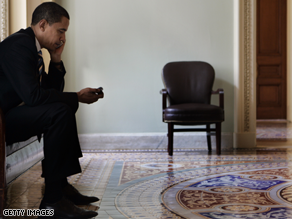
For Obama himself, the trusty Blackberry which never left his side during campaigning has now been replaced by a
While Obama gets 'locked-down', his staff get given the more liberal treatment as the White House counsel have approved (at least temporary) use of GMail accounts for the press office so that information could continue to flow. If GMail, with it’s notorious “all your data are belong to us” policies, can get approval, hopefully other sites can get approval in order to bring the White House into 2009.
Monday, January 19, 2009
Less is Moore
This has resulted in a geometric increase in the processing power of desktop computers, laptops, mobile phones, and so forth. Constant improvements mean that more features can be added to these products each year without increasing the price. A desire to do ever more elaborate things with computers—in particular, to supply and consume growing volumes of information over the internet—kept people and companies upgrading. Each time they bought a new machine, it cost around the same as the previous one, but did a lot more. But now things are changing, partly because the industry is maturing, and partly because of the recession. Suddenly there is much more interest in products that apply the flip side of Moore’s law: instead of providing ever-increasing performance at a particular price, they provide a particular level of performance at an ever-lower price.
The most visible manifestation of this trend is the rise of the netbook, or small, low-cost laptop. Netbooks are great for browsing the web on the sofa, or tapping out a report on the plane. They will not run the latest games, and by modern standards have limited storage capacity and processing power. They are, in short, comparable to laptops from two or three years ago. But they are cheap, costing as little as £150 in Britain and $250 in America, and they are flying off the shelves: sales of netbooks increased from 182,000 in 2007 to 11m in 2008, and will reach 21m this year, according to IDC, a market-research firm. For common tasks, such as checking e-mail and shopping online, they are good enough.
Many companies, it seems, would also prefer computers to get cheaper rather than more powerful. The recession is hurting the computer industry, albeit not as badly as the bursting of the dotcom bubble did in 2000-01 (see article), but those companies that enable their customers to benefit from the flip side of Moore’s law, and do the same for less, will be best-placed to ride out the storm. A good example of this is virtualisation: using software to divide up a single server computer so that it can do the work of several, and is cheaper to run. The more powerful that machine, the more computers it can replace and the less, in effect, each “virtual” machine costs.
The rise of “good enough” computing
The “good enough” approach also works with software. Supplying “software as a service”, via the web, as done by Salesforce.com, NetSuite and Google, among others, usually means sacrificing the bells and whistles that are offered by conventional software. Google Docs lacks the fancy features of Microsoft Word, for example. But hardly anyone uses all those features anyway, and Google Docs is free. Once again, many users are happy to eschew higher performance in order to save money. Even Microsoft has cottoned on: the next version of Windows is intended to do the same as the last version, Vista, but to run faster and use fewer resources. If so, it will be the first version of Windows that makes computers run faster than the previous version. That could be bad news for computer-makers, since users will be less inclined to upgrade. But they are less inclined to do so already. Moore’s law has not been repealed, but more people are taking the dividend it provides in cash, rather than processor cycles.
Sunday, January 18, 2009
The Wisdom of the Taxi Driver
Tuesday, November 18, 2008
Hear from the business....Theo talks about Consumerisation
Theo Kitsos is the VP HR Global Organisational Effectiveness. Hear Theos views about consumerisation and the role that he believes that IT will need to play in the coming years...
Sunday, October 19, 2008
Which segment are you?
We've started to distill out the key questions we need to ask to identify who can benefit most from Freedom of Choice. Aside from all the technical prerequisites regarding applications, we've identified 3 key dimensions. They are.....1. IT Skill - how capable is a user to support themselves. Will they be their own worse enemy? or do they have sufficient skills that they can make and perform basic IT decisions themselves.
2. Role Risk - does the users role within the business support freedom of choice. In 'standard' risk speak - how would they be assessed on Confidentiality, Integrity and availability perspective. e.g. Someone handling customer support issues probably represents more risk than a typical knowledge worker - thereby the IT 'freedom' they are granted may need to be a reflection of that risk.
3. Appetite - Will the users be inherently motivated and happy with the idea that they can make more IT decisions themselves.
Our hypothesis, is that if you find the 'right audience' which is sufficiently motivated, represents an acceptable levels of risk to the business and is sufficiently skilled, the experience of Freedom of Choice will be deeply satisfying.
If you want to know if you're such a person we've put together 15 simple questions which you can find here. It takes 5 mins to complete, and we'll email you the results as soon as we've had a chance to perform the analysis.
Friday, September 26, 2008
Sarah Palin & Consumerisation
On 17 September 2008, hackers posted messages on the Web from the Yahoo e-mail account of Governor Sarah Palin. They did it by guessing the answer to the password reset question she'd set - An answer she had conveniently shared with reporters in an interview she'd done earlier in the year.
The incident highlights the need for a proactive approach to managing consumer services, education/awareness and clear understandable policy. In Palin's case, there was a policy, but as this incident demonstrates, users often ignore / are misinformed about the policy.
The case also highlights the need to understand and assess the risk profile of the individual - what's at stake in the worst case scenario. In Governor Palins case, if a risk assessment had been done it would have become rapidly apparent that any services she utilizes, paper based or electronic are / will be at high risk.
Fortunately, we're not running election campaigns - but we do have to do our utmost to fulfill our 'corporate responsibilities' and protect our corporate brand asset. That's where workforce segmentation plays an essential part (more on this in a later blog).
Sunday, September 21, 2008
1TB Online, Free on the cloud.
So why is it important? Because Oosah is challenging the conventional economics of storage. It does have its limitations: file sizes are limited to 200MB per video and 9MB per audio file and like everything on the net you don't actually know where your files are so if you do try it, exercise the usual cautions and please feedback.
Tuesday, September 2, 2008
Is Chrome Googles new Gold?

Monday, August 25, 2008
Consumerisation Webinar
- What's the real business value of consumerisation?
- Is this the end of the corporate desktop?
- Can users really be trusted?
If you're interested in listening to the discussion, the Webinar was recorded and can be accessed for the next 90 days here.
Monday, August 18, 2008
Go Ahead, Use Facebook
Unilever is featured in the latest edition of BusinessWeek. The article features our very own Wendy Wilkes, and Chris Turner. You can find the article here.
Thursday, August 7, 2008
Is the PC just another company car....?
These are questions that as a consumerisation team we are very interested in....there are many benefits and risks in focus when you start considering what the world may look like if we let certain users in our business choose their own personal IT provision.
Does your PC really need to be treated that differently to company car? Should we let users have more say about what they want?
WHAT IS YOU VIEW??