Sunday, March 22, 2009

Google Voice

Not satisfied with world domination of Search and Email, Google have now launched 'Google Voice', another enterprise relevant service which will be forcing Corporate Telephony service providers to rethink their voice revenue forecasts for 2009.

The essence of Google Voice is that you are issued a single number which is assigned to your plethora of (up to 6) phones (home, office, work mobile, personal mobile, beach hut, garden shed etc). When you receive a call to the Google Voice number all your assigned phones ring simultaneously - the phone which answers first becoming the recipient of the call. If you're not there to answer it goes to voicemail - and a speech recognition engine transcribes and emails what's been spoken as text (text which Google will no doubt find a way of archiving so you can search it later).

Enterprise relevant features of Google Voice...
  1. Free US national calls / Cheap international calls (from 2cents / mins)
  2. Conference Call in up to 4 parties
  3. 'Follow-me' calling (great for travelling execs or home workers)
Conspiracy theorists will no doubt be already considering how Google is going to exploit all this new information but I'm sure many Consumers will overlook security concerns once they realize the service is (currently) FREE. A few journalists are speculating that Google will be monetizing the service by inserting ads either into the voicemail or into the transcripts. Check out David Pogues 1 min demo to get the full jist. (note the service is only currently available in the US).

Tuesday, March 17, 2009

The iPhone Doctor

I’ve tried very hard to resist, but I’ve given in – I have to blog something about Apples 3.0 software update for the iPhone. Apart from the ‘obvious’ stuff (landscape keyboard, cut & paste etc) the one killer new features which stands out for me (based on the longevity and potential) is the hardware API.
This will enable the iPhones to pretty much control anything … from your homes central heating, to your hi-fi to your medical diagnostic peripherals.

Johnson & Johnson have already creates a Glucose Monitoring device using it (lifescan), this will no doubt please Diabetics who will now be considering if an iPhone will become a medical expense?

But seriously, what does a diabetic keep with them night and day beside insulin? Their iPhone right? I’m pretty sure this will reduce the overall cost of producing the glucose monitoring device, improve its usability, and potentially grow the total market size for Glucose monitoring industry. I guess the question in the future will be what won’t the iPhone control, Apple intelligent design + monetization of the apps store + potent user interface, will no doubt drive the natural selection of more brilliant apps which will now integrate and embed into our lives even more deeply.

In short, don’t be surprised to see your iphone interacting with your kitchen appliances (such as your oven), your heart (performing an ECG?) or car – performing diagnostics and telling you that you need an oil change.

The possibility will really be limitless.

Friday, March 6, 2009

Integrating Life

The world largest smartphone manufacture HTC really understand the integrated 'one life' concept, this phone demo has (at least) two modes a 'lifestyle' mode, and a 'business' mode. The social network (facebook) integration also responds to consumer demand for more integrated offerings.

Would Freud use Skype?

Whoever sells those black Woody Allen style psychiatrists couches should watch out. Access to expertise, anywhere, anytime just got a whole lot simpler - so now you don't need to go to Scotland to learn how to make Whisky or have to visit your local family psychiatrist to discover the truth about why you're being chased by a three headed spider with body of your mother-in-law.

Skype have launched Skype Prime, a premium pay-per-min call service which enables you to get in touch with (claimed) subject matter experts instantly through Skype. Apple are similarly cashing in on the 'learning premium', Garageband their music composition software now ships with a guitar learning module so you can become your inner Hendrix. Other places consumers go to learn and expand their mind include VideoJug, an online YouTube for learning, as well as the iTunes > Podcasts > Education, where you literally find thousands of knowledge snippets and lectures from all of the world.

So for businesses, what can we learn from all this? Wouldn't it make more sense to make Brand briefing seminars downloadable for Marketing execs onto their ipod? or for Flight Mechanics to get a video tutorial on how to service on new engine module?

Tuesday, March 3, 2009

254,098 followers can't be wrong ....

Last week I was submitted to a barriage of Twitter related media (Twitterage?). BBC Radio 1's morning anchor Chris Moyles joked about it and TV host, comedian and author Stephen Fry admitted his addiction to it (he's following over 54,345 people, has 254,098 Followers).


Yammer a 'corporate' Twitter, creates closed networks (walled gardens) where only users with the same domain address (e.g .@acmecorp.com) can register (similar to what facebook did when they started, validating affilliation with a US collage). Unlike Twitter which is a true democratised communication channel, Yammers twist (and business model) is based on Corporates wanting to seize control of their networks. For example in the consumer edition of Yammer anyone can say essentially anything (i.e. it's unmoderated). In the paid (Enterprise) edition approved moderators can e.g. remove the offensive / inappropriate comments .


The value of corporate control is clear ... but how realistic is it? - after all employees are already using Twitter, Blogs and other channels outside of corporate control. In a period of history where compliance has never been greater - moderation (read risk mitigation) will be a feature enterprises will want : my conclusion - Yammer will do well.

A wider point perhaps is that Yammer and Twitter do address different social audiences (updating your internal team / business vs. updating the world) - but how sustainable is this division? Are our profressional and personal networks distinct, is there demand for distinction and how will the distinction be managed in the future - through different tools and technologies, or through better channel and message management?

Saturday, February 14, 2009

Mobilizing Sales

Google Docs have now added editing capabilities to Google Spreadsheets from popular phones, including the iPhone and Android phone.

Combine this with the fact that...
1. SAP recently launched a integrated CRM manager for your Blackberry - allowing users to keep track of sales calls and leads.

2. Salesforce.com recently launched a slick iPhone plugin which tracks events, leads, contacts and tasks. (see the demo)

As smartphone device penetration grows naturally through consumer adoption, Enterprises should consider how to...
(a) harness the value of these existing devices
(b) identify key staff who would benefit from one (e.g mobile sales force)
(c) stimulate / incentivize adoption e.g. through negotiated discounts

In an economic environment where every sale counts, and in markets where the entry costs of doing connected mobile CRM are currently uneconomic - these low cost mobile platform extensions offer real potential. (esp. when you consider China, India, Russia and Brazil - all key emerging markets are booming with mobile phone subscribers!)

Does the more portable, better connected, lifestyle-statement iPhone signal the end of the corporate tablet PC as the primarily delivery channel for CRM? If it's cheaper to maintain, setup and run - and more popular with end users the answer has to be - yes!

Saturday, February 7, 2009

Quick fix through Clicks

'Support' accounts for more than half of Enterprise client computing costs today - and staff are the most expensive component of support - so any labour-saving tools or technologies which can help automate and accelerate problem solving will please users and save precious recession-friendly bucks.
Microsoft has recognized this opportunity and is launching 'Fix It'. Clicking on a simple button kicks off a download that, once run, carries out the series of steps needed to fix a specific problem or remove a bug. Microsoft also has plans to extend the click-to-fix system to help users recover from a crash. Fix-it now forms part of a growing arsenal of user self-diagnostic tools including Tune-Up centre, and Windows defender.

If these tools work as intended (not like Microsoft's unhelpful Paperclip) they'll help lower the risks which some users may face from opting out of classic corporate support models - and thereby release funds today tied to expensive support arrangements. This, along with technology which helps isolate and contain apps (like desktop virtualization) will also grow the catchment of potential users who would be suitable to choose their own hardware. If you're a PC users and want to try out Fix-It click here.

Saturday, January 31, 2009

A Newspaper? On a PC? That’s Crazy Talk

In 1981, San Francisco TV station KRON aired a news segment about how a select group of computer users were getting their daily copy of the San Francisco Examiner not on paper, but on their home computer (!). It's a stark reminder how fast the consumer PC market has  has evolved - what's next in your predictions?   

Thursday, January 29, 2009

Gmail Speeds Offline

A couple of killer Enterprise relevant features have been launched in gmail recently .....

1. Beta Offline acccess i.e. Gmail access without a network connection, early reports are that it actually works better than the online version!! If this claim is true it will be yet another nail in the coffin for client based mail (outlook etc). Why would anyone not want to use web based mail?

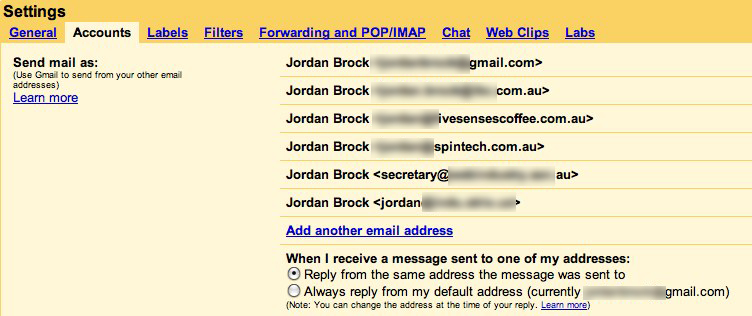
2. Domain aliasing, you can now use your @unilever.com, as an alias for your gmail account. What this means, 1. You can use an iPhone without have to have a VPN tunnel or corporate cert installed, 2. Contactors and 3rd parties can be divested of their corporate devices and email accouts (reducing licencing and hardware provisoning requirements). (Note: You do need to authenticate to prove that you own the original account, so you can't spoof email addresses, when you send an email the reciever sees in the header that it's 'sent of behalf of' - which in a way is a good thing in my view.)


Saturday, January 24, 2009

New job challenges in the White House

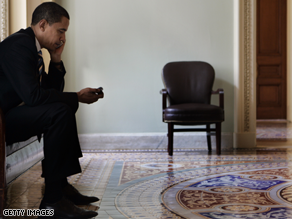
Two years after launching the most technologically savvy presidential campaign in history, Obama officials ran smack into the constraints of the federal bureaucracy yesterday, encountering a jumble of disconnected phone lines, old computer software, six-year-old Windows PCs (his team were a Mac house) and security regulations forbidding outside e-mail accounts. 

In Twitter feeds, Obama's White House staffers claimed they suffered from downgrades on every front.

For Obama himself, the trusty Blackberry which never left his side during campaigning has now been replaced by a
ugly-as-hell uniquely designed $3,300 device from General Dynamics.

Obama - We understand! We know how you must feel. Carrying two devices around, one for work the other for play is not a perfect situation, but then again you are carrying the nuclear codes on your PDAs!

While Obama gets 'locked-down', his staff get given the more liberal treatment as the White House counsel have approved (at least temporary) use of GMail accounts for the press office so that information could continue to flow. If GMail, with it’s notorious “all your data are belong to us” policies, can get approval, hopefully other sites can get approval in order to bring the White House into 2009.

Monday, January 19, 2009

Less is Moore

The esssence and relevance of consumerisation in todays' economist..... (print edition) ....

There is strong demand for technologies that do the same for less money, rather than more for the same price.

FOR years, the computer industry has made steady progress by following Moore’s law, derived from an observation made in 1965 by Gordon Moore, a co-founder of Intel, now the world’s biggest chipmaker. His original formulation was rather technical, and was based on the number of transistors that could be crammed onto a chip, but it was adopted as a road map by the industry, so that it became a self-fulfilling prophecy. In practice, it boils down to the following: the cost of a given amount of computing power falls by half roughly every 18 months; so the amount of computing power available at a particular price doubles over the same period.
This has resulted in a geometric increase in the processing power of desktop computers, laptops, mobile phones, and so forth. Constant improvements mean that more features can be added to these products each year without increasing the price. A desire to do ever more elaborate things with computers—in particular, to supply and consume growing volumes of information over the internet—kept people and companies upgrading. Each time they bought a new machine, it cost around the same as the previous one, but did a lot more. But now things are changing, partly because the industry is maturing, and partly because of the recession. Suddenly there is much more interest in products that apply the flip side of Moore’s law: instead of providing ever-increasing performance at a particular price, they provide a particular level of performance at an ever-lower price.

The most visible manifestation of this trend is the rise of the netbook, or small, low-cost laptop. Netbooks are great for browsing the web on the sofa, or tapping out a report on the plane. They will not run the latest games, and by modern standards have limited storage capacity and processing power. They are, in short, comparable to laptops from two or three years ago. But they are cheap, costing as little as £150 in Britain and $250 in America, and they are flying off the shelves: sales of netbooks increased from 182,000 in 2007 to 11m in 2008, and will reach 21m this year, according to IDC, a market-research firm. For common tasks, such as checking e-mail and shopping online, they are good enough.

Many companies, it seems, would also prefer computers to get cheaper rather than more powerful. The recession is hurting the computer industry, albeit not as badly as the bursting of the dotcom bubble did in 2000-01 (see article), but those companies that enable their customers to benefit from the flip side of Moore’s law, and do the same for less, will be best-placed to ride out the storm. A good example of this is virtualisation: using software to divide up a single server computer so that it can do the work of several, and is cheaper to run. The more powerful that machine, the more computers it can replace and the less, in effect, each “virtual” machine costs.

The rise of “good enough” computing

The “good enough” approach also works with software. Supplying “software as a service”, via the web, as done by Salesforce.com, NetSuite and Google, among others, usually means sacrificing the bells and whistles that are offered by conventional software. Google Docs lacks the fancy features of Microsoft Word, for example. But hardly anyone uses all those features anyway, and Google Docs is free. Once again, many users are happy to eschew higher performance in order to save money. Even Microsoft has cottoned on: the next version of Windows is intended to do the same as the last version, Vista, but to run faster and use fewer resources. If so, it will be the first version of Windows that makes computers run faster than the previous version. That could be bad news for computer-makers, since users will be less inclined to upgrade. But they are less inclined to do so already. Moore’s law has not been repealed, but more people are taking the dividend it provides in cash, rather than processor cycles.

Sunday, January 18, 2009

The Wisdom of the Taxi Driver

Taking a taxi the other day and chatting to the driver, John... he was reminiscing ...

"When I started in this job over 30 years ago, I was employed full time,  the car was provided for me and all I had to do was pick up the jobs"

He went on...

"Today, I own this car, it's my personal insurance... and I pay my own taxes, the only thing the company provides is a list of jobs, in the form of an email. If I want the job I reply to the email, on my blackberry [he shows me the latest blackberry], it's really good deal - I'm self-employed, I take holiday when I want it.... The other funny thing is that because it MY car, I take a lot more care of it. You see young guys today in company cars, and hire cars and they drive them to death".

I asked him, "what standards do the company set for you?"... John went on...

"I have to have a dark car, Black or Blue, and it has to be a Merc (E-Class), Volvo (S70), BMW, or an Audi, the car can't be more than 5 years old, oh and it has to have a service annually. The list gets updated every year, and its my job to make sure that I'm following the rules."

"The other thing I need to do, is my driver proficiency training once a year, at that I learn new driving techniques, we review accident data from the previous year and basically become safer and smarter driver, that's subsidized by the taxi agency"

Intrigued I asked him "Does the company, help you out and offer you any more deals?"

"Yes we get a special negotiated rate on insurance, and also on the cars, the other good thing is that because I'm self-employed I can claim a large part of the tax I've paid against my personal company it works out really well - I just hate having to file taxes every year", he said laughing to himself.

I wondered how long it would be, before we're all 'self-employed'....  our tools of the trade, the Laptop & phone becoming our 'own'?